


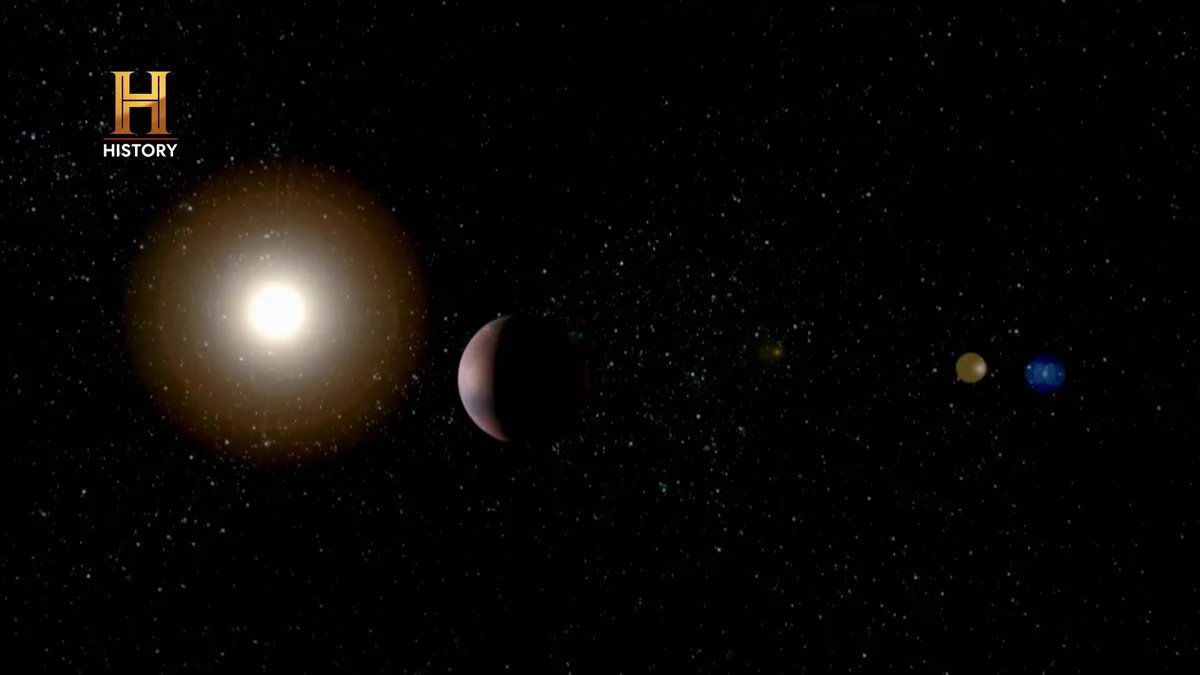
The concept of a Planet X lurking in the frozen outskirts of our Solar System has fascinated both astronomers and cosmic mystery lovers for decades. Now, a new wave of researchers and astronomy buffs is reviving the hypothesis that this celestial body, also known as Planet Nine, might be approaching our solar neighborhood.
The Spanish science magazine Muy Interesante recently highlighted these claims, which are set to be explored in the History channel's program The Nostradamus Effect. According to this line of thought, the gravitational influence of Planet X on trans-Neptunian objects could be the key to proving its existence, even though no direct image of it has been captured so far.
What Is Planet X?
The term Planet X was coined by astronomer Percival Lowell in the early 20th century to describe a hypothetical planet beyond Neptune. Decades later, in 1930, Pluto was discovered and initially thought to be Planet X, but it was later reclassified as a dwarf planet.
Today, scientists who champion the existence of Planet Nine argue it could be an icy world with a mass estimated at 5 to 10 times that of Earth, orbiting the Sun at an extreme distance of 400 to 800 astronomical units (AU). To put that in perspective, one AU is the average distance between Earth and the Sun, roughly 150 million kilometers (93 million miles).
Why Do Some Think It's Approaching?
The theory hinges on the unusual orbits of several objects in the Kuiper Belt, a region of icy bodies beyond Neptune. According to calculations, the gravitational pull of a massive planet could explain these aligned orbits.
Proponents of the approaching Planet X theory rely on computer simulations and the behavior of certain long-period comets. However, official science has not yet confirmed its presence. The very discovery of Planet Nine, proposed by astronomers Konstantin Batygin and Mike Brown from the California Institute of Technology (Caltech) in January 2016, remains a hypothesis awaiting direct verification.
“The evidence is indirect, but mathematically compelling,” supporters say, though they admit a direct telescopic observation is still missing.
The Media's Role and Apocalyptic Theories
The Planet X story is not just scientific; it has also blended with apocalyptic prophecies. From a supposed collision with Earth to a cosmic alignment that could end humanity, the topic is a recurring theme in pop culture. The Nostradamus Effect, which investigates the predictions of the French seer Nostradamus, analyzes how these beliefs connect with the collective imagination.
The History channel has dedicated several episodes to unraveling the urban legend of Planet X, contrasting extreme views with modern astrophysical data.
Could We See It Soon?
Astronomers are working with the Vera Rubin Observatory in Chile, whose LSST (Large Synoptic Survey Telescope) is designed to detect trans-Neptunian objects. In the coming years, new findings could emerge, but scientists urge caution: “there is still no direct evidence,” they emphasize.
Whatever the fate of the mysterious Planet X, its legend will continue fueling both imagination and science. Meanwhile, all eyes are on the sky, searching for a sign that we are not alone in the Solar System.